
Industry Pro: Programming Executive Andrew Paskoff
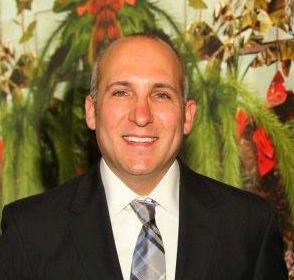 Years ago, I wanted to hire Andew Paskoff before I’d even met him, before he’d even landed in Los Angeles a few years out of college to work in the industry. I did not get the chance and I lost track of him for a while, but thanks to the wonders of social media, we reconnected and he was kind enough recently to fill me in on his career path (hint: his savvy start was followed by many smart moves) and what he’s up to now. Read on to find out more, including why I wanted to hire him all those years ago.
Current position: I am the Vice President of Original Programming, Non-Scripted/Alternative, for Sony Pictures Television Networks, an international cable networks group at Sony Pictures. I oversee original programming and production for reality shows such as “The Amazing Race,” “Top Model,” and “The Apprentice,” being adapted for our local markets outside the U.S.
Hometown: Massapequa. Long Island, NY.
College & degree: I went to the University of Miami, in Coral Gables, Florida. It’s a small school and was even smaller then. I graduated with a degree in Film and Psychology. We all had to double major.
Considering/planning to take the plunge and move to Los Angeles to start or continue YOUR entertainment career? Sign up for a free webinar on June 4th, “The Big LA Move – or Not” to help you with all the questions about deciding to move (do I need to? should I? when?), planning the move (budgeting, scheduling, everything you can do before you go & one surprising thing you can’t do), and making the move (finding a place to live, finding a job, getting connected, starting to pursue your dreams). Sign up here.
Did you have an internship while you were there? I interned at a production company in Coral Gables called Worldwide Production Services, which caters to foreign markets. They do a lot of commercials for the Netherlands, Germany, and Sweden. Because of personal relationships that the owner and my boss (Kim Wolf) had, these companies would come over and set up their production through us and we would shoot the commercials all over Miami and South Florida. Some campaigns would go throughout the United States.
It was really great as a 21 or 22 year-old, being exposed to a film crew. We shot all of our commercials in 16 mm; sometimes 35 mm film. The internship turned into a full-time job after I graduated. It was a great start doing these wonderful commercials. For about a year and a half, I worked with her, and then I moved to Hollywood in 1996.
What was it that made you want to be in entertainment? What were you specifically aiming for? I just grew up in front of the television. I remember going outside and having a social life; but, you know, I just was a TV junkie my whole life. I just always wanted to be in this business. I knew from when I was in high school that I wanted to go to film school and be in entertainment. Everyone is touched by that glamour that we all know doesn’t necessarily exist; but there’s still something exciting about this business. Even though it’s tough and competitive and you’ve got to work hard. I just always wanted to be part of it, and so I went to film school. I knew at some point, even as a 20-something, I was going to have to get out to L.A. and be part of that world. So that’s why I ended up here when I was 23.
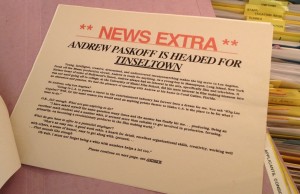 Okay, this is where I come into the story briefly. [Note: As a hiring executive at a film production company, I received a lot of resumes though the mail. The vast majority would be very by-the-book. Sometimes people would try to be clever and usually end up looking sloppy. Andrew sent something very simple and funny, a mock newspaper interview about why he was moving to L.A., that made a strong positive impression on me. I had an informational interview with him, but someone else hired him before we had the right position open.] You know, I have to thank my mother. When I was doing my resume as a 23-year old, she said, “Do something that will make you stand out. Don’t send your resume in a white envelope. Send it in a big, colorful envelope.” So I went out and bought a bunch of colors and I did the newspaper article, to make it stand out as different and creative. The reaction I got from you was really wonderful.
You know, it’s a different world out here. I thought I’d be making movies. Everybody graduates film school thinking they’re going to make movies. That’s a nice, ambitious, bright-eyed, bushy-tailed way to think at 23. And then the reality is you need to make ends meet. My first job when I got here was as a post production assistant at Witt/Thomas Productions. At the time, they were making sitcoms. They were famous for “Golden Girls” and “Soap.” They did “Herman’s Head” and “It’s a Living” and a few others that were really popular in the ’70s and ’80s. And when I was there, they were making a show called “Pearl” for CBS with Rhea Perlman, “Brotherly Love” with Joey Lawrence and his brothers, and “The Larroquette Show,” with John Larroquette working at a bus station.
It was a really nice way to be exposed to the working stages of Hollywood. We had a show on each of the different networks. I was a post production runner and I really ran around this town. I mean, now I put 4,000 or 5,000 miles on my car per year. My first year in Hollywood, I put over 20,000 miles on my car.
Tell us a little bit about your career path from there. Why did you leave Witt/Thomas? The company scaled back when several of the shows were canceled. Everybody went in a different direction. I got a job at that point as freelance Production Coordinator on a few commercials with a production company that was based out of Raleigh Studios. I was just trying to make ends meet.
From that job, I started doing some small feature films with a friend of a friend out of Miami, who’s a producer. Her name is Maureen Mottley and she’s still making movies around the world. Then, as a freelancer, I’d work maybe six weeks or, if I was lucky, six months. After that, I was looking. I took a lot of gigs working with temp agencies. I’ve had some real doozies. Good and bad. I just wasn’t going to sit around.
I ended up at a longterm gig in circulation at “The Hollywood Reporter.” It was a very basic 9-to-5 job and they wanted to keep me. I thought about it for a moment and I just said to myself, “I don’t want to do this for the rest of my life.” So I told them “no” and moved on. At one point, I even worked at the Gap in the Beverly Center. I was 24 and instead of working on a show, this was what I was doing to make rent. That was a low for me, personally and professionally.
Then I just really got lucky. My friend Maureen hired me for this documentary feature on comedy at the end of the millennium. It was called “The Millennium Project,” and several feature film directors each chose a different topic. It was kind of my crossover into reality and features because we did a lot of interviews and clip licensing, and we put together this 90-minute+ film.
That led me to a production company in the Valley where I started working on different reality shows. The rest is history. I went from job to job; and produced steadily with a few different companies and some producers that I would work with that I’m still friends with. It was the late ’90s. The reality television business was really starting to explode, and I was just working as a Production Manager here in L.A. through 2002. Then I decided to move back to New York.
This was a decision I made with my twin brother who had moved out here with me. My father had passed away in 1999 and my mother was living alone in downtown New York, in the area where the Twin Towers fell, Battery Park. My brother and I just said, “We’ve never lived in New York. Let’s go give it a shot.” We were maybe feeling a little beat up by L.A. at that point. We’d come out here together wanting to write. We did have representation in the late ’90s and early 2000s. We had an agent at Paul Kohner Agency and a bunch of scripts that we wrote were out there for consideration. We were trying to break in as a brother writing team, but had had no break.
 So we went back to New York. My brother set us up, found us an apartment. I moved back, and fairly quickly I got a job in New York as a production manager on “Blind Date” and “The Fifth Wheel.” It was perfect timing and they were great for what they were at the time. That was in 2003. It took me from April to December. It was like a great kind of way to jump into the New York market and meet all the New York people doing reality at the time. I worked pretty steady from there, on a ton of different shows. I was working on TLC shows and Discovery shows and then I got into the MTV world through someone who I’m still friends with. The relationships that you build when you’re working with people 12 to 16 hours a day for 8 weeks to longer – those are still so important to me.
I continued to freelance through 2004 and then a friend of mine from L.A. moved to New York, got a job at MTV, and brought me onto one of his shows. One thing led to another and toward the end of 2005 there was an opening for a Line Producer at MTV, a staff position, and I got that job. That’s where my corporate career started. That was really a dream job at the time. MTV’s such a wonderful place. A lot of great people have been through “the MTV factory,” and it’s a great place to work and learn.
I was on staff with them through 2007 and then I decided to move back to L.A. They transferred me to the Los Angeles office and I was with MTV in LA through most of 2008. In the summer of 2008, somebody I had met at MTV in New York, who was on staff at Sony asked if I was interested in working there. I took that job in September 2008, and I’ve been with Sony ever since, first as Director of Production and then Executive Director. I was most recently promoted to Vice President. And here we are today. It’s been a roller coaster, but a really good one.
It’s interesting talking to people involved in the globalization of media. I interviewed Judith McHale not long ago. She was part of growing MTV outside the US and then, as President and CEO of Discovery Communications, led the growth of that company to a global media conglomerate. There’s some great programming coming out around the world, whether U.K. formats or Dutch formats or even Sweden now. But the U.S. still has that cachet.
So now that we’ve covered your path, I’m going to ask you a series of questions. Can you give me an example of a “Eureka!” moment you’ve had, where you realized you did or did not want to do something or where you had some kind of shift? There were definitely a few jobs where I struggled. I remember I did a feature in Death Valley. I think I was promised $700 for the whole project or something ridiculous like that. Ultimately, I didn’t even get paid because the producer was this bad guy. He was ultimately banned from his own set because people just despised him so much. I was working for about two to three weeks on this film. I just felt really alone and kind of icky. I realized maybe working in features wasn’t the place for me. I didn’t jibe well in that world, and so I shifted to television. It was in 1998 or ’99, when reality really started to take off and there were a lot more jobs and I just started feeling more comfortable in television and with the sort of people I was meeting.
So let’s jump a little bit to the deep dark past. What was your worst job or worst day in the entertainment industry? I would say it was that feature film that I did in the late 90s. There was a line producer who hired me and then she quit the day I started. So I ended up doing everything. Like I said, I was really alone on the feature; me, and a creepy producer and a director who was too big for himself. There was really no one I could turn to for anything, and it was a lot of pressure and stress. That was my worst experience in the industry.
 Okay. So, conversely, what was your best job or best day in the entertainment industry? I did an MTV show in New York in 2004 called “Damage Control.” I was the Production Manager and we did 16 episodes in a very short amount of time. It was a hidden camera show. We would go into people’s homes in cahoots with the parents and/or a best friend and we would outfit the home with 24 to 30 hidden cameras. We cut into the walls and placed cameras behind them and behind mirrors and different artwork and, you know, all over the house except bathrooms.
The parents would set their child up for the weekend and go away, leave the kid at home. We’d have all these different events happen, usually over 24 to 36 hours. It was just such a great experience, meeting all these different people in the tri-state area who wanted to get one over on their kid. We always put the house back the way we found it, but it was a big build-out. We had some celebrity guests like Vanilla Ice and Kelly Clarkson, when she’d just won American Idol. They would just show up at the house, looking for directions to a store or that kind of thing. It was all this fun, pranky stuff and great seeing how the kids would react to all these different scenarios. That was really my entrance into MTV. I had done a few shows, but this was like really being part of the network. It was them getting to know me and me getting to know them. Just the friends that I made and the memories – it was really an incredible experience.
That’s great. Okay, so what’s the best thing about your current job? The best thing about my current job is the shows. I love the shows that I do. Also, I love that I get to travel. I’ve never been afraid to get on a plane and go somewhere. I never had any kind of fear of just going in there alone and having to find my way to the office and connect with people I’d never met before. I love meeting people, seeing different cultures, trying new food, and seeing how shows are made around the world, which is really both similar but yet different everywhere. So it’s been great.
I’m looking for a brush with greatness. It can be a celebrity encounter or just being exposed to someone being brilliant at what they do. I’ve had both celebrities and just people I admire. Celebrity wise, Jim Burroughs was the director of the first sitcom I worked on here in L.A. “Pearl.” Just watching him work was really a highlight for me. I’ll never forget it. I admired him so much. He was doing “Will and Grace” and had done “Cheers.”
I’ve worked with some really incredible people. One of my best bosses and somebody I really admire wasn’t a direct boss, he was overseeing the department. His name is Chris Linn and he is now the Executive Vice President of MTV programming and production, overseeing the network and, really all the creative and production operations. He is somebody I still admire and speak to. I always liked working with him because he had this very even temper. He had a really great sense of work/life balance and he always made sure that we all did, too.
Okay, so what’s the one thing that you wish you’d known when you started in the business? I wish I’d gotten some talent agency experience. I never really had that inside experience, whether it was at a desk or in the mailroom. I just think there are great things to come from that because of the relationships and just how exposed you are to different aspects of the business. So when I talk to people just starting out, I tell them working in an agency is a great way to start.
What do you think makes you good at what you do? I think the combination of not cracking under pressure, being flexible, liking people, and having the production experience I had before Sony, which was a lot of numbers and schedules and logistics. I really have a knack for budgets and calendars and making it all work together. It works for me.
What advice would you give someone just starting out either in entertainment or on the same path as you? I give people two pieces of advice: One is to try the agency route and the other is to network. This business is all about networking and relationships. I’m seeing it now with friends of mine. When we all started in the business, we didn’t know anybody. Now I have friends who are running networks. They’re presidents of production companies. I never thought I’d know the people at that level. It happens, you know, over time.
Last question: What’s your next move? Where do you see yourself going from here? I’ve thought a lot about this. I love the international market. I got married in September and my husband works at Mattel. He’s a marketing director on some global brands. So we’ve talked about moving overseas, possibly. We’ve thrown out Asia, Australia and London. We think London is probably a little more realistic for both of us, because we both have good options there. I’d like to continue working there, if we end up relocating to London in the future.
If you liked the information contained in this post, subscribe to Your Industry Insider to get weekly emails about new content, free webinars, and special offers. Become a Your Industry Insider today!
ENTER YOUR EMAIL ADDRESS HERE & PRESS SUBMIT


Comments

About JennyYM
Jenny Yerrick Martin is a veteran entertainment hiring executive with 20+ years in film, television, and music. She created yourindustryinsider.com to give students, recent grads and others a true picture of the layout of the industry, and how to break in, transition to a new area, or achieve more success on their current path.


