
Industry Pro: Tech Adviser and Writer Jim Clemente
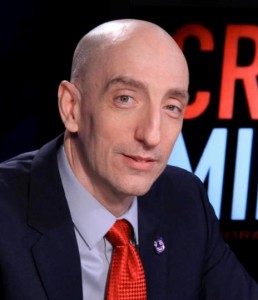 Some entertainment careers are carefully calculated far in advance, while others emerge out of some odd twist of fate. For today’s industry pro, a veteran FBI profiler, a one-time meeting with an actor researching a role turned into a side position as a tech adviser on a network television show. He added freelance writing on the show to the mix, and then producing his own scripted and non-scripted shows, all the while staying true to his passion for educating people on criminal behavior. He couldn’t have planned it better. Read on to find out more…
Current position (or recently-completed project or projects): I have multiple positions at this point. The longest running ones are on “Criminal Minds.” I have been technical adviser since the beginning of the show and I started writing episodes as a freelance writer in the second season. I’m doing both of those things now. When we did the spinoff, “Criminal Minds: Suspect Behavior,” I was the producer on that show as well as a writer, but unfortunately that one got canceled.
I’m also the tech adviser on a couple of other shows, some new and some that have faded into the past, and I tech advise on features. I have written and co-written some pilots and also produced and been on air-talent on a number of nonscripted series. I’ve shot four or five different pilots over the past couple of years and executive produced them, as well as being on-air talent. We just finished one, called “Killer Profile,” for its first season.
Lastly, I consult on criminal and civil cases and as an expert in the field of profiling or criminal behavior analysis as well as sex crimes and child abduction. So I still do real cases in the real world and testify as an expert witness.
Hometown: I was born in San Mateo, California and grew up in New York. The last 15 years, I lived in Washington D.C. and Virginia while I was a profiler. I retired three years ago and have been spending most of my time in L.A.
College & degree: I went to Fordham University in the Bronx, New York, majoring in chemistry with a minor in philosophy. I went to Fordham Law School, got a Juris Doctor, and then was a prosecutor in the New York City Law Department after that for three years. While there, I worked a case with the FBI and at the end of that, they recruited me. I was an FBI agent for 22 years.
So when you were a kid, did you aspire to be in law enforcement? And what about entertainment aspirations? How did you end up on the path that you are on? It’s kind of a circuitous route. When I was a kid, the only books I ever read were “The Hardy Boys” and “Sherlock Holmes” mysteries. I tried to read all of them, but I read very slowly. Turns out I had dyslexia that was undiagnosed. I thought I was just stupid. Math and numbers were very easy for me so I gravitated toward sciences in school. I always wanted to be a detective, though; I liked figuring things out. I didn’t think there would be any connection to law enforcement though. I never even considered the FBI, but when I worked the case with them, the agent I worked with had actually been an attorney, too. He told me that FBI agents were nothing more than federal detectives. I liked that.
It’s a year-long process to get in. You go through the background investigations and testing and interviewing. I made it. I thought I would do it for about five years and then become an Assistant United States Attorney, still using my prosecution skills. It was way too fun and way too diverse. It kept me going for 22 years.
Were you based in D.C.? I started out in New York. I got on the Whitewater case so I was in Little Rock, Arkansas for about 14 months. I built a case against Web Hubble, the Associate Attorney General at the time. And then I got transferred to Washington D.C. I worked Cold Case Homicides, and Major Cases. And then I was promoted to Supervisory Special Agent as a profiler and moved down to Quantico where I worked for the last 12 years of my career.
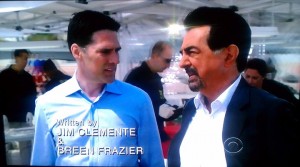
Screenshot of Jim’s credit with Jim in the background
How did the entertainment aspect of it come in? As I said, it was a circuitous route. I had found out I was a dyslexic when I was a junior in college and I started getting these eye exercises to help correct that. I started reading more and more. When I was a kid, like I said, I read Sherlock Holmes and Hardy Boys books. I really respected people who could put all these words together in a book. I thought that was an amazing feat. I had a couple of uncles who had written books, who were pretty good authors. One was a speechwriter for President Kennedy. I always looked up to them, but never thought I could be a writer.
So then, 9/11 happened. I was one of the first responders. I ended up getting lymphoma along with about 50 cops and firefighters and eight other FBI agents, all within a short period of time. I had to have a bone marrow transplant as a result. That took me out of commission for work for a while. So I was sort of working from home when Mandy Patinkin came to Quantico to talk to our profilers. He was considering the lead role in a new series called “Criminal Minds.” He talked to some people there and, apparently, he asked the guy who was bringing him around, “Isn’t there anybody here with any kind of personality?” I guess he was just talking to administrators. I got a call from my friend. He said, “Look, I have this actor here. You know, he wants to talk to somebody with some personality and I thought of you.” I said, “Well, look, I’m recovering from a bone marrow transplant. You can’t come to my house, but I can meet you some place. But I have to wear a face mask and gloves.” He said, “All right. Fine.” So I went out and met him. I walked in the door. Mandy walks up to me. He says, “Hi, I’m Mandy Patinkin.” I say, “Of course, you’re Mandy Patinkin. You think I’m stupid?” He busted out laughing. I felt like an idiot walking around like this, but it broke the ice.
We sat down and he asked me, “What’s your very best case and what’s your very worst case?” I started telling him stories. In the end I took out my wallet and showed him a picture of this kid, a six year old boy I helped save well after we thought he was dead. I said, “I carry this in my wallet. This gets me through the ones that don’t work out like that.” He took out his phone and said, “Yeah, I’ll do the show.”
Then he said he wanted to pattern his character after me. He took pictures of my office and I went out and met the executive producer, Ed Bernero. It turned out he had been a cop. We hit it off pretty quickly. I said, “I’d love to help you. As long as you help us do our job and don’t hurt it.” He said, “What do you mean?” “If you insult cops or you have us come in and take the case away from cops or, you know, disrespect them, the cops in the real world are going to think that’s what we’re like. But if you make it that we’re working with the cops, it’s their case and we’re just helping… if you can do that, I will be happy to help you.” I’m now on Season 9 of helping them.
Was there a question about whether you could do that and continue doing your job? You weren’t retired. You were just on medical leave, right? I was back at work, I think, by the time they really went into production. You know, there was no question I was going to keep doing what I was doing. I was an FBI agent. I had no thoughts of leaving. I think that’s one of the things they respected about me. I was helping. I wasn’t getting paid. I couldn’t supplement my salary with an outside job without some kind of approval. I did it because it was an opportunity to teach.
So how did you go from just being the technical consultant to also writing? As I said, I was into chemistry and math. Formulas are very easy for me. When I started watching the show, I realized right away that it was a formula. There was a pattern. I had no idea what a script was or how to write it but I saw the pattern of the show. And in the second season, I said to Ed, “You know, I’d like to write one if I could.” Not knowing anything about unions or how you go about doing this or Final Draft software or anything. I said, “I would like to write one.” And he was like, “Well, what do you have in mind?” I told him the story that I had in mind and he was like, “Sounds great. Why don’t you try it?”
Now, you know, it goes through drafts and notes and all of this stuff. It’s definitely a group effort in the writer’s room and in the draft process. In the end, it came out pretty well. It was called “Lessons Learned.” It was about a situation where the DEA breaks into what they think is a meth lab. It turns out it was a dirty bomb factory. They go down to the prison at Guantanamo to interrogate a suspect. It was going to be a bottle episode, just Mandy in the room with this guy. They just didn’t know if it would be interesting enough to carry an episode. I wrote the first draft and had the back-and-forth, fleshing out the story and the details of what I knew about Gitmo. They said, “Wow, this really is good. It is important.” It teaches that torture is bad, that we can actually use our brains to get information out of them instead of being physically violent and violating the Constitution. So it was great. It had a great message. It did really well. I got the writing bug at that point. So I’ve been fortunate enough to have written six now and I’m working on another one.
So what’s the best entertainment career advice you ever got? Ed Bernero, the Executive Producer, told me, “You’ve had so many varied experiences and have been involved behind-the-scenes. You have seen worlds that people want to know about, so you have the opportunity to write from your experience and not just from your imagination. Your imagination can fill in little details and glue things together, but the fact, is you should write from your experiences, from the truth of your experiences. You will never be able to make up stuff like the experiences that you have had.” That has totally rung true, especially when I am in the room trying to sell an idea or talk about an episode I want to write or develop a new show. When I’ve told the real stories behind the idea, people usually respond extremely well. It’s been the thing that has allowed me to be successful to the extent I have so far.
So describe a typical workday in your position on “Criminal Minds”? Well, a typical workday at the beginning of a season is going into the writers’ room, and sharing our thoughts and ideas about new cases we want to cover that year and where we want the characters to go. Typically, I will tell stories about cases as things come up. People will mention topics. I will say, “That reminds me of this case…” Or, “My friend Joe had this case…” Or, “Me and Fitz did this…” I tell them about events that actually transpired; they frantically take notes and then pick and choose what they want to do. Also, as new writers come onto the writing staff, I spend time teaching them what behavioral analysis is. How we don’t focus on the forensics but the reason why they did this or that and that leads us to who did it. So we use victimology and the behavior exhibited at crime scenes to reverse engineer back to the type of person who committed the crime. That is a new way of thinking for most of the writers that have come on. Once they learn that, it’s a lot easier.
I basically help in breaking the stories. I help in giving notes when the outlines and drafts come in and then I usually punch up the profiling stuff. It’s a two month process for each episode. It’s certainly a lot quicker in network television than it is in features. It can be a number of years from the time you think of an idea from the time you actually sell it to the time you get to write it to the time it gets shot to the time it gets edited to the time it gets into theaters. Whereas in TV, you can come up with an idea and two months later you are watching it.
Do you also have assigned scripts as well? Since I retired, I have been doing one every season. I will submit a few examples of cases that I’d like to cover and the type of bad guy, and then they let me know which ones the network likes and I go through the same two-month process myself.
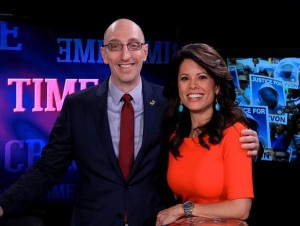
On Crime Time set with Loni Coombs
Eureka moment (when you realized you did or did not want to do something or that you should do something differently, etc.): The first time I saw a segment that I had written, which basically talked about the statistics of child abductions and of those children who were abducted and murdered: 44% were killed within the first hour, 74% in the first three hours, 99% in the first 24 hours. When I saw the character of Dr. Reid walk into a green screen and then appear on a playground with 10 kids playing in the playground and then basically half of them disappear when he’s saying 44% are gone in the first hour. And then three quarters of them disappear when he says 74% and then there’s one kid swinging on a swing. He said 99% are gone within 24 hours and then that kid just disappears and the swing is swinging empty and the hair stood up on the back of my neck.
When I realized that in that one hour, I reached 18 million people with important information that in my 12 years in the BAU, I probably taught about 50,000 cops and professionals around the world. In one hour, I get 18 million people and I think by the time it goes around the world in syndication, it’s like 100 and something million people. I realized this is an amazing way to teach people. We can teach people without them knowing they are learning. It really made an impression on me as to why this is a very important medium and why I should contribute.
Worst job or worst day in the entertainment industry: Probably the worst day in the entertainment industry was the day that we found out that “Washington Field,” the pilot my brother, Ed Bernero, and I did for CBS wasn’t being picked up. We shot it. It came out great. We were really excited about it. We found out that they were going to put “NCIS L.A.” on the air and not ours. That was a bad day. But many people don’t even get the opportunity to get there, so I have to look at positive side of it. It was a great experience. But, it was a bad day finding out we weren’t going forward.
And then conversely best job or best day in the entertainment industry? I think the best day was probably the last day of shooting my first episode and what was amazing was that here I was maybe, you know, one year out of fighting for my life and surviving a bone marrow transplant. I was in Hollywood shooting my first ever episode of network television and everybody did such an amazing job. Everybody I just know that 300 people behind the scenes are working their butts off every day to try to make this be the best thing in the world and everybody came sort of together at the end and thanked me. I wanted to thank them and they were thanking me for what I do for a living for real because they get to portray it on TV. It was an amazing moment and really touching and really a bonding moment for me with the cast and crew and writers and producers. I will remember that forever.
What is the best thing about your current job? Nobody really dies. You get to kill off people fictionally and then you get to shake their hands and tell them great job and have lunch with them.
The worst thing about your current job? Boy, probably the unpredictability of it. I’m used to a world where even though I don’t know who the next criminal is or where I’m going to be going to try to catch them, I do know the basic parameters of what is going to happen on a given day. In Hollywood, it seems to be totally unpredictable. It’s completely fickle in what decisions are made or not made and the timetable is so spread out that there’s a complete disconnect between expectations and what actually happens.
So now I’m looking for a brush with greatness. It can be a celebrity encounter or just being exposed to someone being brilliant at what they do. I was invited to the dedication ceremony for a U.S. stamp in Gregory Peck’s image at the Academy of Motion Pictures. It was really an amazing event. It was the first time I had ever been there. I was sitting on the end of the row. I watched a bunch of stars like Sharon Stone and Morgan Freeman get up to make amazing speeches about Gregory Peck and his legacy.
Morgan Freeman said, “I remember as a young actor I was sitting on the end of a row in this very room and Gregory Peck comes walking down the aisle. I was so overwhelmed, I stood up. I couldn’t even speak. What I ended up doing, I needed to tell him what an inspiration he was. I fell down to my knees. He just said in his voice, ‘Get up, kid.’ But I just had to pay homage to him.” So he said that, right? And at the end of the event, across the aisle two rows in front of me, was Sydney Poitier. He stood up and turned around and had this glistening, amazing smile. I went up to him and I wanted to thank him for all of the work he had done, the pioneering work that he had done in this industry. I just said, “I’ve got to do this.” I dropped down to one knee and I shook his hand. He was just overwhelmed. He pulled me up into this bear hug for like two minute and was literally tearing-up in his eyes. He said, “Thank you, thank you very much.” I said, “Stop. You don’t have to thank me. You’re a prince and I’m so honored to meet you.” It was just an amazing moment. That was my brush with greatness.
So what is the one thing you wish you had known when you started in entertainment? How much I didn’t know. When I look back to how little I knew about the industry and about the unions and about different jobs and what the responsibilities were and how complicated it was and how much really went into putting together a production on a major network show, I probably would never have had the guts to say I would like to write one of these. I just didn’t know. In my ignorance, I think they were very, very kind to me to let me sort of fumble my way through it. But the fact is that it is an amazing group effort. It’s something that I was just completely ignorant of. I thought, you know, writers wrote. Producers produced. Actors acted. The crew did their thing behind the scenes. I didn’t know how it all went together, how symbiotic it was and how important it was that everybody has their job and has to do it to their utmost.
What is your advice to somebody coming up behind you? Internships. I think internships are the most important way to do two things: One is to test your own interests and abilities in a job. Two is to give potential employers an opportunity to see how interested, how dedicated, and how hard working you are. For both of those reasons it’s the most important thing anybody coming into this field should do. It’s going to give you more than any school or any other type of experience could ever give you.
So what’s your next move? Where do you see yourself going in the industry? I have been doing a lot lately in the unscripted world. I spent a lot of time working on news type programs, doing case analysis and so forth, but also getting involved in the internet shows that go into more depth and detail about hot topics. I have been involved in this show called “Crime Time” on the Internet. I usually do an interview a week, an in-depth analysis about crimes and trials and so forth. I’m also working on a couple of projects that might take that format to the networks.
If you liked this post, subscribe to Your Industry Insider to get weekly emails about new content, free webinars, and special offers. Become a Your Industry Insider INSIDER today!
ENTER YOUR EMAIL ADDRESS HERE & PRESS SUBMIT


Comments

About JennyYM
Jenny Yerrick Martin is a veteran entertainment hiring executive with 20+ years in film, television, and music. She created yourindustryinsider.com to give students, recent grads and others a true picture of the layout of the industry, and how to break in, transition to a new area, or achieve more success on their current path.


