
What We Can Learn from the Making of Swingers
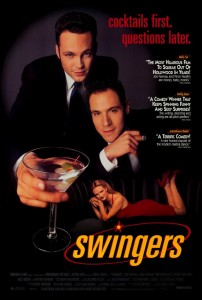 In case you missed it, Grantland recently ran a fantastic “Oral History of the Making of Swingers.” It’s a must-read for aspiring entertainment professionals, so if you didn’t catch it, well, you must. And if you haven’t seen the iconic mid-90s movie, well… you get the idea. When you see the movie, even though you can tell it’s not a big-budget flick, you recognize right away a coherent, well-made independent film.
This makes reading the piece about how it got made all the more impressive. At any step of the way, it could’ve been derailed. No money, no permitted locations, no proper production office, no coffee. There are just some of the many issues that came up during Swingers’ road to release. And then, after all they went through to get it out, the film was a box office disappointment.
Ultimately, the film found its audience on home video. It launched the careers of Jon Favreau, Vince Vaughn, director Doug Liman, and others, and it’s now a classic film of its time. There are plenty of takeaways for anyone preparing to – or waiting for the right opportunity to – make their mark in the industry.
Here are a few of them:
1) They were entertainment industry rookies who wanted to empower themselves.
Many of the actors, as well as most of the behind-the-scenes players, were just underemployed twenty-somethings trying to make something happen in their careers. As Jon Favreau, the screenwriter and one of the stars of the movie put it, “I had been broken up with by my old girlfriend from Chicago who I’d lived with, and I was taking it pretty hard and I was feeling pretty lonely. And then I was realizing that even though I had been in movies already, the work was not going to come easy — that frustration brought on the writing. I was taking things into my own hands.”
Are you interested in working in the entertainment industry? Check out “Breaking Into the Biz: The Insider’s Guide to Launching an Entertainment Industry Career” for step-by-step guidance on identifying, pursuing, and landing the right first job on the path to your chosen entertainment goal.
Vince Vaughn put it this way: “I remember saying to Jon after auditioning for a lot of stuff that we weren’t seeing the best material. Even the movies that were getting made, I thought, were not dialed into the time period, not really capturing real life. I said to him, ‘Ya know, it would be great if you didn’t have to audition for this stuff,’ and then Jon went and wrote Swingers.”
TAKEAWAY: Do I really need to say it? How can you take control of your own entertainment career? Dig in! If you want to be a comedy actress, put up a one-woman show, make a web series, do standup. If you want to be a producer, find something to produce. This applies to people in all areas of the industry. If you want to be a music manager, offer to manage an unrepresented up-and-coming band. Don’t wait to get cast or hired. Cast yourself! Hire yourself!
2) They were friends collaborating.
Not only were most of the actors friends, the line producer, Nicole LaLoggia, and many of the other behind-the-scenes players were also in Favreau’s social circle at the time. Even the director, Doug Liman, was a friend, although for a long time, Liman refused to read the script. “I knew Jon had a script he’d written that he was trying to raise money for. I had made it my policy at the time to never read a friend’s screenplay in the interest of preserving that friendship, you know, because inevitably your friend’s screenplays were not good,” he said. Later, though, he relented: “Jon started asking me a bunch of questions, because I had been to film school and I had made a bunch of short films and this straight-to-home-video movie. I still didn’t have any real experience, but compared to somebody with none, I had answers. Finally, I was like ‘You know what? I should just read your screenplay. I can’t answer these questions without reading it, so how about I just read it?’ So I read the script and loved it.”
Liman raised the money from one of his dad’s wealthy friends (after trying 100 others, he says) under the condition that if he brought the financing to the table, he would get to be the director. Though Favreau had wanted to direct it, the movie arguably wouldn’t have gotten made without that money.
TAKEAWAY: Find a way to work on your friend’s dream while advancing toward your own, too. After all, who would be better than your friends to band together and make something under the radar? Who else would you rather endure long hours, no pay, no budget, and foxhole problem-solving with? And who else would you want the opportunity to celebrate with when it’s done.
3) They did whatever it took to get the job done, EXCEPT one thing.
First, let’s get the one thing Favreau wouldn’t – or couldn’t – do. “I sent the script to my agent,” Favreau explains. “She sent it out and there were some nibbles. People were interested in optioning it, but they had a lot of notes. They wanted to change Vince’s character to a girl and have them not go to Vegas and said the dialogue was too repetitive, and it had to be darker and more violent. I was really trying to embrace the notes. I tried to change the script, but I just couldn’t.”
Vaughn explains the bigger picture – why the changes being requested were so crucial to getting the movie made (or not) within the Hollywood system, “The business model was always a problem. You have a bunch of guys that don’t really mean anything to Hollywood. Jon had done more than the rest of us, but wasn’t a big enough name to open a movie. And they always felt the movie was funny but also very specific to out-of-work actors in Los Angeles. I think they all totally missed the universality of it: a guy dealing with a breakup and coming of age, taking a journey with a group of friends, and wanting to meet somebody to love. Everyone goes through it.”
So, as Favreau says, “From that point on, we set out to try and really make the thing on our own.” The oral history then goes into the sketchy circumstances under which the movie was made.
Here are just a few snippets from the various players in the filmmaking process:
“We couldn’t afford office space, so the production headquarters was in our house.”
“Nicole’s office was in an unfinished garage in the backyard with dogs running around and stuff.”
“Our entire lighting package was gonna consist of 100-, 150-watt light bulbs.”
“Our coffee budget was zero. We had it donated.”
“Saving on shooting time and movie lights is a big factor, but you still need locations. And Nicole used to cry in front of people, literally. No technique was beneath us to get people to give us things for free or cheap.”
“Instead of getting a traditional caterer, we made deals with restaurants in the neighborhood for next to nothing.”
“Vince’s car was always breaking down or out of gas. Twice, he came in with so little gas that the car ran out as he was approaching set and I had to siphon gas out of other cars.”
(From Liman) “Every day I was telling Jon something else that was un-kosher and he was getting more and more alarmed. Not hiring a DP, a director of photography, seemed to be the thing that particularly [troubled him]. And then one day — a few weeks before we started shooting — he caught me reading a book on basic movie lighting.”
“I called this place in L.A. that does recycled, re-canned short ends and I just begged for the cheapest price we could get.”
(From Liman) “The problem with shooting on short ends, though, is that it takes four minutes to reload a conventional camera. I thought to myself: We’ll never get through the movie if we shoot a minute, spend four minutes reloading, shoot a minute, spend four minutes reloading. You’ll never get any kind of rhythm going. So I decided I would shoot the movie with this documentary 35-millimeter film camera that was not designed to shoot dialogue because it sounds like a sewing machine… To absorb the sound, I would take my down jacket and put it over the camera and then take the two arms and tie them together underneath the lens. And then my comforter would just get wrapped around the whole thing once. Jon would describe it like he was acting in front of a big, fluffy snowball.”
“There was never enough time and never enough film.”
“Every day we’d panic because I was shooting more film than I thought I was gonna shoot and we didn’t have enough film and we didn’t have any money.”
“I used to hide film in the trunk of my car because Doug could not help himself. He just wanted to shoot, shoot, shoot, so we would lie to him and say that we were out of film.”
“The scene where he’s in the apartment and he opens the fridge for no reason and there’s a light in there? I’ll never forget Jon pointing that out to me. He whispered to me at the premiere — he was laughing — he was like, ‘You see when I open the fridge for no reason? That’s because Doug said the scene was too dark and we needed to light it, we needed more light.’”
“The Reservoir Dogs rip-off shot — I actually went and shot that, just me and Doug — in the alley out of a flatbed truck behind a 7-Eleven. We did it in the middle of the night and just ran and hauled the boys out of bed at two in the morning and shot it three times and packed it up, and said, “Let’s go.” It was the only way to do it.”
TAKEAWAY: When nothing can stop you, NOTHING can stop you.
4) They were faced with doubters and naysayers every step of the way.
Remember, no one knew if what they were making would be any good – or even get seen – or even get finished, for that matter. “None of us were counting on this movie for anything,” says Liman. “I didn’t even tell my agent I was making Swingers until I was done shooting it because I didn’t want him to stop looking for a real job.”
Also according to Liman, their sound man, who usually worked on porn flicks, but who was all they could afford, would say to them on a daily basis, “This movie is pretty cute, but let’s face it, nobody’s gonna see this but your friends.”
The low budget forced them to beg, borrow and steal opportunities to shoot in real locations with actual patrons as extras. Liman says, “We were shooting in a trendy bar and suddenly I ran into some classmates from film school and I could just see the way they were looking at me — with this big poufy thing on my shoulder and some actors and a scene lit with lamps from a discount home store — that they were thinking Doug’s lost it. Just that, like, this poor guy, maybe he showed some promise in film school, but he has clearly gone off the reservation. This is not how you make a movie on any level. There is no aspect of this that looks professional.”
For the party scene, according to LaLoggia, they got some friends who had a cool old house to allow them to shoot in it. “We asked them if they would throw a party that we could film but not tell anybody we were gonna film it. And obviously people saw cameras in there once we all arrived, but they still didn’t know what it was about, and people in L.A. love that stuff.”
Adam Scott (actor, now on “Parks and Rec”), who was one of their friends, says, “I was at that party. We would see them walking around, shooting these little scenes. And we had no idea what it was they were doing.” Mike White (actor/director), who was also there, says, “I remember them shooting and I actually thought, at the time, This is so embarrassing for them.”
Liman says about that party, “It may have been the low point of the filming. Nobody was taking our film seriously.”
TAKEAWAY: At the time, it was a party with these embarrassing filmmakers in it. Now, it’s a part of film history. Regardless, who cares? It gave the guests something interesting to talk about.
5) Their lives were changed (and would have been even if the movie hadn’t become a pop cultural phenomenon).
After a somewhat contentious negotiating process with Harvey Weinstein, the movie was bought by Miramax for $5 million. As actor Ron Livingston describes it: “But this is where the Weinsteins were so smart. They started getting the idea of ‘We’re not just buying the movie, we’re buying relationships with the filmmakers. We’re going to be in business with Jon Favreau. We’re going to be in business with Vince Vaughn. We’re going to be in business with Doug Liman. And if we ever want to do anything in the future with these guys, we’ve got this over their heads to say, Hey, we started you out.’ It’s just really, really smart business.”
Jon Favreau, Vince Vaughn, Doug Liman…These were guys that nobody had heard of before this movie.
Says Favreau, “Vince used the dailies from that monologue in the trailer and eventually ended up getting a television deal for a few hundred thousand dollars, which was a king’s ransom to us. We had never seen any kind of money like that. He was like the richest guy I knew. He would pick up dinners and pay for drinks; I mean, he was a big shot.”
Even the swing band in the movie’s career was rocketed. Glen “the Kid” Marhevka (Big Bad Voodoo Daddy) recalls, “We played the Super Bowl halftime show. We played for three presidents. We played for Clinton, we played for some big dinner for Bush Sr., and we played some big dinner for Bush Jr… Clinton was bitchin’, because we got to hang with him. When he came to us he sat with us for like 10 minutes and was completely talking to us about saxophone and about his experiences and his collection of saxophones. It was cool, man — that was an awesome experience. And that was all 100 percent due to Swingers.”
As I said above, though, it didn’t wow at the box office. Says Favreau, “It wasn’t a hit by any stretch of the imagination. On both sides of us, we had Good Will Hunting and Sling Blade, two other releases from Miramax that made a lot of money and we just didn’t, we didn’t hit the mark. It felt like a disappointment. And it wasn’t until years later that it built momentum on video, and became part of the culture and the language, that it became what it is now.”
Liman explains, “I got a call from somebody at Buena Vista Home Video who said, ‘Miramax screwed up. Your movie is way too good to disappear like that, and we want to give it a huge push on home video.’ They used to have these events where they’d fly the owners of Blockbuster and all the video store chains out to L.A. for three days and Mel Gibson would give the keynote address. They were gonna make the whole weekend Swingers-themed and do events at the Derby and screen Swingers for all of them. Meanwhile, I got a call from MTV that I had been picked as Best New Filmmaker for the MTV Video Awards. That event took place right around the same time that the home video weekend happened. And so suddenly if you went into a video store there’d be 20 copies of Swingers, like it was a big movie, everywhere in the country.
TAKEAWAY: You hear this story a lot in independent filmmaking. These guys making Swingers, the Napoleon Dynamite filmmakers, the Good Will Hunting crew… They kills themselves to get their movie made and it launches them. And there are many, many other examples of movies you haven’t heard of that have changed the lives of one or more of the people involved. Now it happens with web series and You Tube videos, too. It doesn’t even have to be catapulting their career forward. It can just give them the heightened confidence and skill set to land the next level opportunity. This applies to the aspiring music manager who helps a band develop a following, too. It applies to anyone who goes out and gets the job done, whether the people around him believe in him or not. Go ahead. Even if it doesn’t change your life, it will change your life.
6) They changed other people’s lives.
As the introduction to Grantland’s “Oral History of the Making of Swingers” so aptly put it, “It was a movie about feelings for guys learning to be men, predating the modern Apatovian bromance by years. Swingers had its own restorative slang and presented a world — or a part of Los Angeles, anyway — with a version of cool that seemed both exotic and utterly attainable. It introduced characters so instantly loved and relatable that guys began assigning those parts to their own friends. Trents dancing on tables, saving vulnerable Mikeys from their own doldrums, were everywhere. We got in touch with our inner Robs, placing value on patience and listening.”
“Growing up, my cinema was Laemmle’s Sunset 5,” says actor Joseph Gordon-Levitt. “When I was 16 and got my license, I would drive over Laurel Canyon to see anything that was playing there: Sling Blade, Big Night, Trees Lounge, Daytrippers. I saw Swingers there — twice. I went with my buddy from high school. We were so stoked about the movie, we went back in and saw it again immediately afterward. Spending time in the world of twenty-something guys who are on the prowl for chicks — that’s what you dream of doing when you’re 16.”
“It wasn’t just a movie, but something that meant something to people who were going through a similar experience,” explains Associate Producer Avram Ludwig. “It made them feel better. It gave them someone to relate to. I met this kid one time who claimed to have seen the movie 20 or 30 times. I said, ‘Why did you see this movie that many times?’ And he said, ‘You don’t understand. I go out, I get rejected by girls, and then I go home and watch Swingers.’”
TAKEAWAY: Who doesn’t want to change lives? Make things happen for yourself and change some lives too, if you can.
What takeaways can you add to the above?
If you liked this post, subscribe to Your Industry Insider to get weekly emails about new content, free webinars, and special offers. Become a Your Industry Insider INSIDER today!
ENTER YOUR EMAIL ADDRESS HERE & PRESS SUBMIT


Comments

About JennyYM
Jenny Yerrick Martin is a veteran entertainment hiring executive with 20+ years in film, television, and music. She created yourindustryinsider.com to give students, recent grads and others a true picture of the layout of the industry, and how to break in, transition to a new area, or achieve more success on their current path.


